


How to Create a Mini “Emergency Earning Plan”: Build a Practical Income Backup Before You Need It
Why You Need an Emergency Earning Plan
If your main source of income disappeared tomorrow, what would you do first?
Most people do not have a clear answer.
They may know they could sell something, look for temporary work, or ask someone for help.
However, those are loose possibilities—not a usable plan.
An emergency earning plan is a written list of realistic ways you could generate a specific amount of money within a short period.
It is designed for situations such as:
A sudden reduction in work hours
A delayed paycheck
The loss of a client
An unexpected household expense
A temporary gap between jobs
A small emergency that exceeds your available cash
The goal is not to replace your full income overnight.
It is to create a short-term financial bridge.
For many people, a reasonable first target is $250 to $500.
That amount may help cover groceries, transportation, a utility payment, medication, or part of another urgent bill.
It will not solve every financial problem, but it can give you time to make better decisions.
The best time to identify these earning options is before financial pressure arrives.
Once an emergency begins, stress can make it harder to recognize resources, compare choices, and act strategically.
A written plan allows you to begin with direction instead of panic.
💡 Build a Backup Before Pressure Arrives
A small income plan can give you more control when your regular cash flow is interrupted.
👉 Build smarter financial habits today:
Small financial shifts create long-term freedom.
An Emergency Earning Plan Is Not a Side-Hustle Fantasy
An emergency earning plan is different from building a business or creating a long-term side hustle.
A business may require market research, branding, equipment, advertising, and months of consistent work.
A side hustle may also take time to establish before it produces dependable income.
Your emergency plan has a narrower purpose: identify what you can do with the resources, abilities, and access you already have.
A strong option should meet most of these conditions:
You can begin within a few days.
The startup cost is low or nonexistent.
You already possess the necessary skill or item.
Someone has a clear reason to pay for it.
You understand how to reach potential buyers.
Payment can be collected quickly and safely.
The income estimate is reasonably predictable.
This keeps you grounded.
“Start a popular online store” is not an emergency earning action.
“List five unused tools locally for $40 each” is.
“Become a freelance designer” is too broad.
“Offer three simple flyer designs to local businesses for $75 each” is specific enough to evaluate and execute.
Your plan should contain actions, not ambitions.
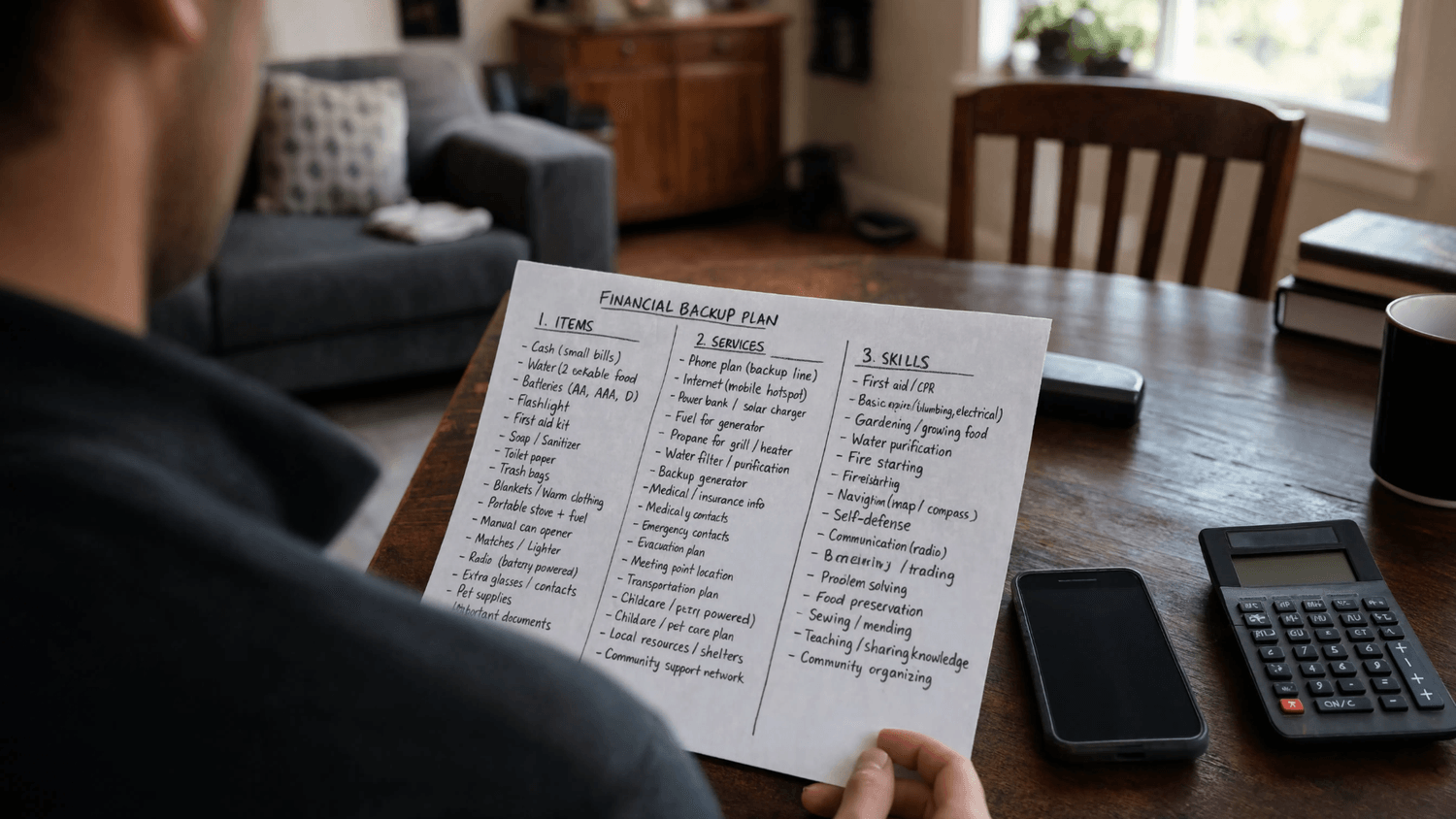
Start With a Clear Dollar Target and Deadline
A vague goal such as “make some extra money” creates vague action.
Give your emergency earning plan a number and a deadline.
For example:
> Generate $400 within seven days without borrowing money or using a credit card.
That statement defines the mission.
You can now work backward and determine what combination of actions could reasonably produce the money.
Your target should be:
Large enough to provide meaningful relief
Small enough to remain realistic
Connected to an actual short-term need
Divided into manageable earning units
Suppose your target is $400.
You do not necessarily need one opportunity worth $400.
You could build a combination:
Sell an unused appliance for $125
Complete two local service jobs at $75 each
Tutor for three hours at $35 per hour
Sell one digital resource for $20
That produces $400 through several smaller transactions.
This approach reduces your dependence on a single buyer or opportunity.
If one action fails, the entire plan does not collapse.
Also establish two timelines.
Your primary plan might target seven days, while your backup plan extends to 14 days.
This gives you an immediate goal without pretending every transaction will happen instantly.
Take Inventory of What You Can Monetize
Before searching for new opportunities, examine what is already available to you.
Your earning inventory should cover four areas: possessions, practical services, knowledge, and reusable work.
1. Possessions You Can Sell
Look for useful items that you no longer need, especially items with active local demand:
Small appliances
Tools
Electronics
Furniture
Exercise equipment
Collectibles
Unopened household products
Hobby supplies
Seasonal equipment
Quality clothing or shoes
Do not base your estimate on what you originally paid.
Base it on what similar used items are actually selling for in your area.
A realistic price often generates cash faster than holding out for the maximum possible amount.
Speed has value during an emergency.
Protect yourself when selling locally.
Use reputable platforms, communicate through their messaging systems, meet in a safe public location when appropriate, and avoid unusual payment requests.
2. Practical Services You Can Offer
People regularly pay for help that saves them time, effort, or frustration.
Your service does not have to be innovative.
Possible services include:
Dog walking or pet sitting
Yard cleanup
Snow removal
Furniture assembly
Basic technology assistance
Grocery pickup
House cleaning
Moving help
Decluttering assistance
Local delivery
Administrative support
Simple photo or video editing
The question is not merely, “What am I good at?” Ask, “What problem can I solve this week that someone already wants solved?”

Turn General Skills Into Specific Offers
A skill becomes easier to sell when it is packaged as a clear result.
“I can help with computers” leaves too many unanswered questions.
A customer does not know what you will do, how long it will take, or what it will cost.
A stronger offer would be:
> I will organize your computer files, remove unnecessary startup programs, and help you back up important documents for $75.
Other examples include:
Format and proofread a résumé for $50
Create three social media graphics for $60
Provide a one-hour beginner smartphone lesson for $40
Assemble one standard desk or bookshelf for $65
Tutor a student online for $35 per hour
Photograph and list ten resale items for $80
Organize a small closet for $75
Each offer identifies the task, result, scope, and price.
Specificity also protects your time.
Without clear boundaries, a small job can expand into hours of unpaid work.
State what is included, what is not included, and when payment is due.
💡 Turn Existing Skills Into Clear Income Options
You do not need ten new income streams.
Start by identifying one useful result you can deliver reliably.
👉 Build smarter financial habits today:
Small financial shifts create long-term freedom.
Include Digital and Remote Possibilities
Your plan should not depend entirely on local, physical work.
Remote services and digital resources can provide additional options, particularly if transportation, health, weather, or scheduling limits what you can do.
Remote services might include:
Virtual administrative assistance
Proofreading
Basic research
Online tutoring
Transcription
Data cleanup
Presentation formatting
Customer follow-up
Simple graphic creation
Video captioning or trimming
If you already have useful digital materials, you may also be able to convert them into a small product. Examples include:
A budgeting worksheet
A household maintenance checklist
A résumé template
A meal-planning sheet
A printable planner
A short instructional guide
A social media template
A niche reference list
Digital products are not automatically fast money.
You still need a buyer and a way to reach that buyer.
Include a digital product in your emergency plan only if it is already created—or can be finished quickly—and you have a realistic distribution channel.
Do not spend an emergency week designing a complicated product that nobody has requested.
Start with something simple, useful, and close to completion.

Score Each Option Before Adding It to Your Plan
A long list of ideas can feel productive while still being unusable.
Evaluate each earning option against the same criteria.
Give every idea a score from one to five in these categories:
Speed: How quickly could you receive payment?
Certainty: How likely is someone to buy?
Profit: How much would remain after expenses?
Access: Can you begin with what you currently have?
Effort: Can you complete it without creating another problem?
Repeatability: Could you use it again if necessary?
An unused television might score high for speed and access but low for repeatability because it can only be sold once.
Dog walking could score high for access and repeatability but may produce a smaller amount per job.
A specialized service may offer better profit, but finding a buyer could take longer.
The scoring process prevents you from choosing options based only on excitement.
It also exposes hidden costs such as:
Platform fees
Shipping expenses
Transportation
Materials
Childcare
Taxes
Payment delays
Time spent locating customers
The highest advertised payment is not always the best emergency option.
A $200 job that requires $80 in materials, several hours of travel, and a two-week payment delay may be less useful than two local $75 jobs paid immediately.
Build Three Layers of Earning Actions
Your final plan should contain more than one type of action.
Layer One: Immediate Cash Options
These are actions you could initiate within 24 hours:
List an unused item
Contact someone who previously requested your help
Offer a specific local service
Accept an available short-term shift
Follow up on money already owed to you
Layer Two: Short-Term Service Options
These may require a few days to schedule:
Tutoring
Cleaning
Yard work
Technology assistance
Freelance editing
Administrative help
Pet care
Layer Three: Repeatable Backup Options
These can strengthen your financial position beyond the immediate emergency:
A monthly service client
A reusable digital product
A recurring weekend shift
Consistent resale of a product category
A skill you can offer through referrals
The immediate layer helps address today’s pressure.
The repeatable layer helps reduce the chance that your next disruption becomes the same emergency all over again.

Create the One-Page Emergency Earning Sheet
Keep the finished plan short enough to use under pressure.
A one-page document or notebook sheet is enough.
For every earning option, record:
The exact offer or item
The expected amount
Where you will find buyers
The first action required
The estimated time to payment
Any upfront expense
A backup action if it does not work
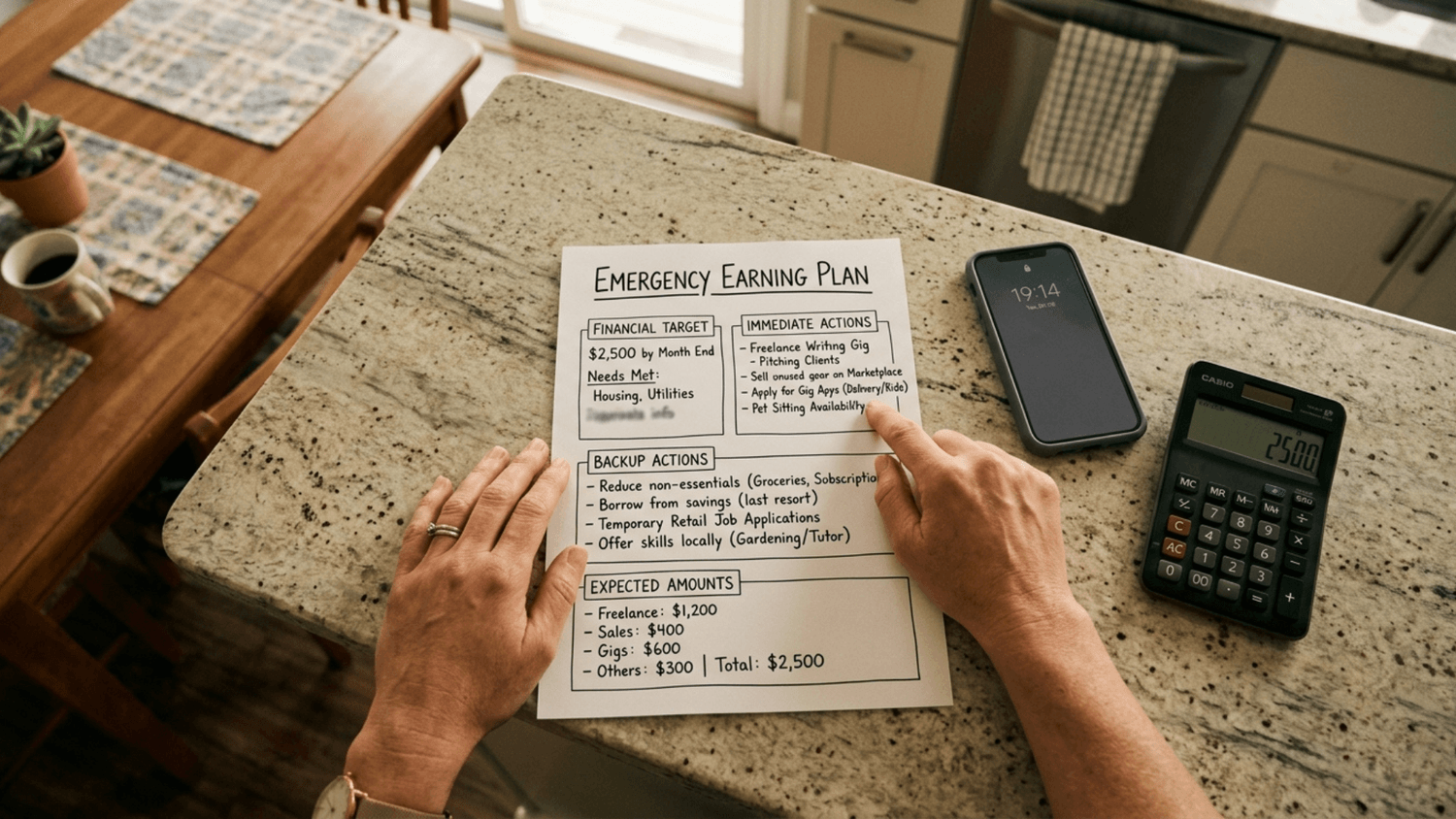
A sample plan might look like this:
Goal
Earn $500 within ten days.
Primary Actions
Sell unused exercise equipment: expected $150
Complete two organization jobs at $85 each: expected $170
Provide three hours of online tutoring at $40 per hour: expected $120
Format one résumé: expected $60
Backup Actions
Offer weekend pet sitting
List two smaller household items
Take an available temporary shift
Contact former clients about short projects
First 24 Hours
Photograph and list the exercise equipment
Message three previous contacts
Post one clearly priced service offer
Reserve two evening work periods
This is specific enough to execute.
It also gives you multiple ways to reach the target.
Prepare the Tools Before an Emergency
A plan becomes more valuable when the basic materials are already prepared.
Consider creating:
A folder containing clear photos of items you may sell
A short description of each service you can provide
A simple pricing list
A reusable customer message
A list of local selling platforms
A list of people who may refer work
A safe payment method
A basic way to track income and expenses
You could also write a short service message in advance:
> I have two openings this week for basic home organization.
I can organize one small closet or storage area for $75.
The service includes sorting, grouping, and setting up a simple arrangement using the containers you already have.
That message is clearer than announcing that you are “looking for side work.”
It tells people what you offer, what it costs, and why they might need it.
Preparation reduces hesitation.
When money becomes tight, you can adapt and send an existing offer instead of struggling to create one from scratch.
Avoid Turning the Emergency Into a Larger Financial Problem
Urgency can make risky opportunities look reasonable.
Protect your finances while trying to improve them.
Be cautious of:
Jobs requiring a large upfront payment
Buyers who send more than the agreed price
Requests to purchase gift cards
Unusual checks or payment reversals
Expensive training sold as immediate income
High-interest borrowing presented as a solution
Opportunities promising guaranteed returns
Platforms that hide payment schedules or fees
Work that puts your safety or property at unnecessary risk
Also avoid selling essential equipment that supports your employment, transportation, health, or household stability unless you have carefully considered the consequences.
Selling a rarely used game console may provide useful emergency cash.
Selling the only computer you need for work could create a larger income problem next week.
Fast action still requires sound judgment.
Test the Plan While You Are Stable
You do not need to wait for an emergency to discover whether your ideas work.
Test one action when the pressure is low.
List one unused item.
Offer one clearly defined service.
Try to earn the first $50 or $100.
A small test teaches you:
Whether your price is realistic
How quickly people respond
Which platform works best
What questions customers ask
How much time the work requires
What expenses you overlooked
Whether payment arrives as expected
Update the plan based on evidence.
Remove weak ideas and strengthen the ones that produce results.
Review your emergency earning plan every three to six months.
Your possessions, skills, schedule, contacts, and local opportunities will change.
A current plan is far more useful than an old list built around circumstances that no longer exist.
💡 Strengthen Your Income Safety Net
Test one earning option now, document what works, and keep the strongest choices ready for future use.
👉 Build smarter financial habits today:
Small financial shifts create long-term freedom.

Final Thought
An emergency earning plan is not a guarantee that every financial disruption will be easy.
It is a way to replace some uncertainty with preparation.
You do not need a perfect business, a large audience, or an impressive new idea.
You need a realistic target, a few specific earning options, and a clear first move.
Write down how you could generate your first $250 to $500.
Identify what you can sell, what service you can provide, who might need it, and how quickly you could be paid.
Then test one option before an emergency forces you to rely on it.
Financial resilience is built through practical choices made in advance.
A small, tested earning plan gives you something valuable when income becomes uncertain: a place to begin.

Categories


Trending
Curious about Java Burn? Discover how this fat-burning coffee additive works, what ingredients it uses, and if it’s right for your daily routine.
Looking for real ways to make extra money in 2024? Here are 15 legitimate side hustles and online income ideas that actually work — no scams, no fluff.
Discover how to build real confidence using small, science-backed micro-habits. No fluff — just proven strategies that actually work.

About me

Hi there 👋 My name is Lisa Grove, I'm the maker of This Blog. One of my favorite things is travel, fun and sun :)
💡 Keep Exploring: Handpicked Reads for You

Discover proven strategies to attract leads using Facebook & Instagram — no ad budget needed.

Learn how to write subject lines and content that get clicks, opens, and responses.

Start your journey toward financial freedom with this simple, proven framework.
📬 Want Smart Marketing Tips in Your Inbox?
Join our free newsletter for weekly tips that help you grow faster and smarter.
© 2025 reebesthelp.com. All rights reserved.